






Common Pixel Pitch Selection Mistakes — And Their Long-Term Cost Consequences
Every pixel pitch mistake has an immediate symptom and a long-term cost. The immediate symptom is usually visible on installation day — an image that looks wrong, a budget that has been exceeded, a client who is not satisfied with what they approved on paper. The long-term cost is less visible but often far greater: replacement cycles that arrive earlier than planned, operational compromises that accumulate quietly over years, and the reputational damage that follows when a high-profile installation underperforms.
The mistakes below are not theoretical. They are patterns that recur consistently across commercial LED display projects of every scale, in every market. Understanding them in advance is the most reliable way to avoid paying for them later.

Mistake 1: Over-Specifying Pixel Pitch for the Viewing Distance
This is the most financially costly mistake in the entire specification process, and it is also the most socially acceptable one — because spending more on a finer pixel pitch feels like a responsible decision at the time it is made.
The logic seems sound: a higher-resolution display will always look better than a lower-resolution one, so choosing the finest pixel pitch the budget can accommodate appears to be the safest and most professional approach. In practice, this reasoning consistently produces specifications that cost significantly more than necessary while delivering no perceptible improvement in the viewing experience.
The immediate cost is straightforward. Moving from a correctly specified P2.5 to an unnecessary P1.5 for a lobby installation viewed at a minimum distance of 4 meters can increase the per-square-meter panel cost by 60 to 100 percent depending on the manufacturer and volume. For a 15-square-meter installation, that premium can represent tens of thousands of dollars in additional expenditure that the end user’s audience will never perceive or appreciate.
The long-term cost is where over-specification becomes genuinely damaging. Finer-pitch panels carry higher LED density, which means more individual emitters per module, more solder points, more thermal load concentrated in a smaller physical area, and more complex calibration requirements over the display’s operational lifespan. In practical terms, this translates into higher spare module costs when replacements are eventually needed, more skilled technician time required for maintenance, and a narrower field of compatible replacement components as product generations evolve. A display that was over-specified in 2024 may find itself in a situation where its fine-pitch modules are no longer in active production by the time a section requires replacement in 2030 or 2031 — forcing either a costly partial panel replacement with mismatched components or a full display refresh years ahead of what the application actually demanded.
The opportunity cost compounds the financial impact. Budget that is absorbed by an unnecessary pixel pitch premium is budget that cannot be allocated elsewhere. In practice, this often means that ancillary elements of the installation — the video processor, the mounting structure, the content management system, the extended warranty or service contract — are either under-budgeted or omitted entirely. The result is a display with exceptional pixel density that is driven by an inadequate processor, maintained without a service agreement, and showing content that was never produced at a resolution that justifies the hardware. The most expensive component of the installation ends up being the one that delivers the least incremental value.
How to avoid it: Apply the viewing distance formula before any manufacturer conversation takes place. Define the maximum viable pixel pitch for the space and treat specifications finer than this threshold as requiring explicit justification — not as automatic upgrades. Direct the budget headroom toward display brightness, processor quality, and service coverage instead.
Mistake 2: Under-Specifying Pixel Pitch for the Viewing Distance
The inverse mistake occurs when budget pressure, a lack of technical familiarity, or an overly optimistic reading of the viewing distance formula leads to a pixel pitch selection that is too coarse for the space. Unlike over-specification, this mistake does not hide itself. It becomes apparent the moment the display is powered on in front of the first audience.
Visible pixelation in a professional environment carries a specific kind of reputational cost that is difficult to quantify but easy to understand: it signals that the technology decision was made incorrectly, and it reflects on everyone whose name is associated with the project. For system integrators and AV consultants, a visibly pixelated installation in a client’s boardroom or flagship retail location is a case study they would prefer not to have in circulation.

The immediate cost of under-specification is the remediation expense — which, in most cases, means a full panel replacement rather than a cost-effective fix. Unlike a software configuration error or a processor settings issue, a pixel pitch mismatch is a hardware problem with no software solution. The modules that are installed are the modules that will remain installed until the display is replaced. There is no firmware update that reduces visible pixel gaps.
The long-term operational cost of a pixelated display in a customer-facing environment is measured in user behaviour. In retail environments, displays that produce a poor visual impression lose the attention of the audience they were installed to capture. In corporate environments, meeting room displays with visible pixelation are progressively abandoned in favour of laptops and portable screens for presentation purposes — rendering a capital investment in a fixed display effectively unused. In both cases, the asset continues to appear on the balance sheet while delivering diminishing operational value, until an unplanned replacement budget is eventually allocated to correct the original specification error.
The specific scenarios where under-specification most commonly occurs follow a recognisable pattern. Conference room displays are specified using the average seating distance rather than the minimum — ignoring the front row of seats closest to the screen. Retail displays are specified based on the distance at which the display looks acceptable rather than the distance at which customers actually engage with the content. Control room displays are assessed visually in a manufacturer’s showroom under showroom lighting before being installed in an environment where analysts sit significantly closer to the screen than the showroom demonstration suggested.
How to avoid it: Measure the closest viewer position on site, not the average viewer position. Where the installation is in a space still under construction, apply a conservative distance estimate and revisit the specification once the space is closer to completion. When evaluating a specification under budget pressure, reduce screen area before increasing pixel pitch — a smaller display at the correct pixel pitch will consistently outperform a larger display at an inadequate one.
Mistake 3: Evaluating Pixel Pitch Without Assessing Cabinet and Seam Quality
Pixel pitch describes the density of light-emitting elements within an individual module. It says nothing about what happens at the boundaries between modules, or between the cabinets that house them. Yet for many viewers in real-world installations, the visual quality of those boundaries has a greater impact on perceived image quality than pixel density itself.
Cabinet seams — the physical joints between adjacent LED modules or panels — are visible under certain conditions as thin dark lines that divide the display surface into a grid pattern. At fine pixel pitches, where individual pixels are already very small, seam visibility can become the dominant visual artifact that viewers notice, effectively negating the resolution advantage that the fine pitch was intended to deliver.
The immediate cost of poor seam quality is difficult to address after installation. Unlike brightness or colour calibration, which can be adjusted through software controls, physical seam width is determined by the manufacturing tolerances and mechanical design of the cabinet system. A display with poor flatness tolerance — measured as the deviation in planarity between adjacent modules — will exhibit light leakage, shadow lines, and uneven brightness at module boundaries that are particularly apparent on uniform-colour backgrounds such as white presentation slides and blue-sky video footage.
The long-term structural cost of inadequate cabinet quality compounds over time. LED display cabinets are subject to thermal expansion and contraction through daily heating and cooling cycles. Cabinets with insufficient mechanical rigidity or inadequate joining hardware will develop progressive misalignment at the seam points as the display ages — meaning that a seam that was marginally acceptable at installation becomes increasingly visible over the following two to three years of operation. This mechanical degradation is accelerated in outdoor installations and in indoor environments with significant temperature variation, such as spaces with inconsistent air conditioning coverage.
The specification mistake is evaluating pixel pitch from manufacturer datasheets without requesting physical samples or visiting a reference installation. A P1.8 display from a manufacturer with excellent module flatness tolerances will consistently outperform a P1.5 display from a manufacturer with poor mechanical quality — and the price differential may favour the higher-quality P1.8 option. When evaluating competing proposals at similar pixel pitches, always request the manufacturer’s flatness tolerance specification in millimetres, and treat anything coarser than ±0.1mm between adjacent modules with caution for close-range applications.
How to avoid it: Request a physical demonstration of the display at close range on a solid white or light grey background before committing to a specification. Seam quality issues that are invisible during a dynamic video demonstration become immediately apparent on static light-coloured content. For installations where seam visibility is a critical concern — broadcast studios, high-end retail, corporate brand environments — specify cabinet flatness tolerances explicitly in the procurement contract rather than relying on general quality assurances.
Mistake 4: Comparing Pixel Pitch Specifications Across Different LED Technologies
A P1.5 specification from one manufacturer is not the same as a P1.5 specification from another if those two manufacturers are producing displays using fundamentally different LED technologies. As the LED display industry has diversified across traditional SMD, flip-chip, COB (Chip-on-Board), and Mini LED architectures, direct pixel pitch comparisons between different technology platforms have become an increasingly unreliable basis for specification decisions.
The practical implication is significant. Two competing proposals both quoting P1.5 may be offering products with substantially different fill rates, contrast ratios, colour gamut capabilities, reliability profiles, and long-term maintenance characteristics. Selecting between them on pixel pitch and price per square meter alone ignores the variables that will actually determine the display’s performance and total cost of ownership over its operational lifespan.

COB technology, for example, encapsulates LED chips directly into a resin surface layer rather than mounting discrete SMD components onto a PCB. This produces a display surface that is physically more robust, less susceptible to individual LED damage from contact, and capable of achieving higher contrast ratios through improved black levels. For high-traffic environments — interactive installations, touch-enabled displays, public-facing retail screens — the durability advantage of COB over traditional SMD at equivalent pixel pitches carries a meaningful long-term cost benefit in reduced maintenance and component replacement frequency.
Mini LED technology achieves very fine pixel pitches through reduced chip dimensions rather than architectural changes to the mounting method, producing displays capable of very high brightness at fine pitch specifications that were previously difficult to achieve with standard SMD components. For applications requiring both fine pitch and high brightness — semi-outdoor installations, environments with strong ambient lighting — Mini LED specifications at a given pixel pitch may deliver significantly better practical performance than a traditional SMD specification at the same nominal pitch.
The long-term cost of technology mismatch most commonly manifests in maintenance and serviceability. A COB display and an SMD display at the same pixel pitch have very different module repair processes. COB modules that develop dead zones typically require full module replacement rather than individual LED repair, which affects both the cost and logistical complexity of maintenance operations. In markets where technical service support for COB technology is less widely available, this can create a situation where a display that was priced attractively at purchase becomes expensive to maintain in the field.
How to avoid it: When comparing proposals at equivalent pixel pitches, require manufacturers to specify the LED technology architecture alongside the pixel pitch. Evaluate fill rate, contrast ratio, and surface construction alongside the pitch number itself. For any installation with a planned operational lifespan of five years or more, include a detailed assessment of local service availability and module replacement cost in the total cost of ownership calculation.
Mistake 5: Neglecting Refresh Rate in Camera-Facing Applications
Refresh rate is a specification that appears on nearly every LED display datasheet and is overlooked in nearly every specification process that does not involve a broadcast or live events professional. For the majority of commercial applications — digital signage, corporate displays, retail screens — this oversight carries limited consequence. For any installation where the display will be captured by cameras, the consequences range from aesthetically unacceptable to professionally damaging.
An LED display with a refresh rate below 3,840Hz will exhibit visible flicker and horizontal banding when captured by cameras operating at standard video frame rates. This effect is invisible to the human eye in person but immediately apparent in camera footage — including footage captured on modern smartphones, which are now sufficiently capable to expose the issue on consumer-grade devices. In an era where event photography, social media content, video conferencing backgrounds, and live streaming are standard components of how organisations present themselves, a display that photographs poorly is a display that will generate negative documentation of the installation every time it is captured on camera.
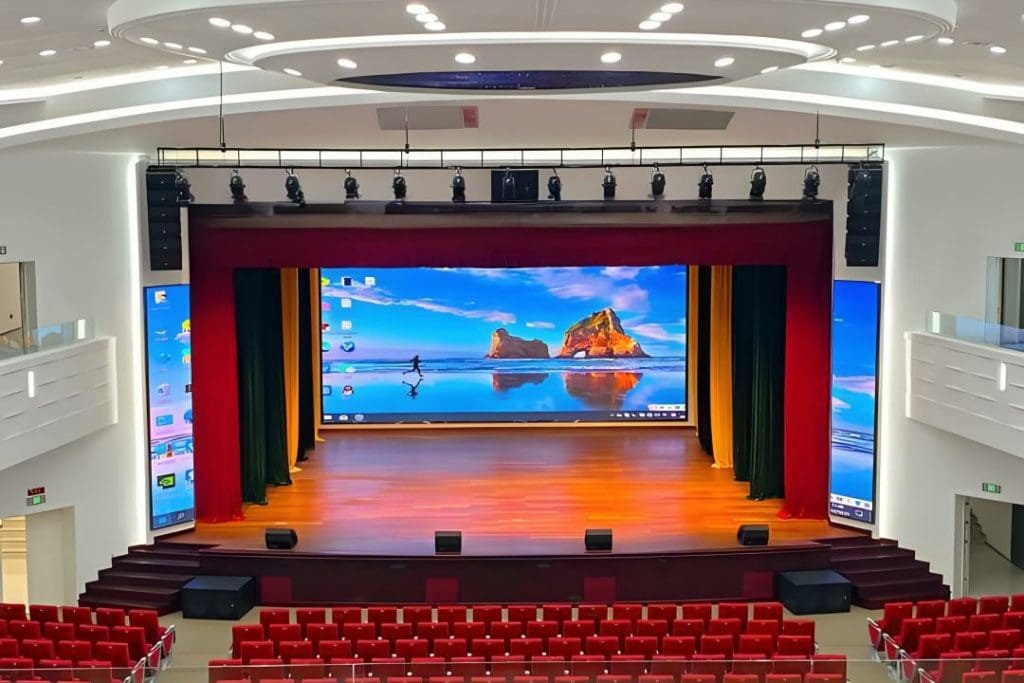
The long-term reputational cost of this mistake is disproportionate to the specification detail it involves. A corporate client who installs an LED video wall as a brand backdrop for executive presentations and media events will, at some point, discover that every photograph taken in front of it shows a display with visible banding. At that point, the display has become a liability in precisely the context it was installed to enhance — and the cost of replacing it to correct a specification error that could have been avoided for a modest premium is a difficult conversation for everyone involved.
The financial cost differential between a display with a 1,920Hz refresh rate and one with a 3,840Hz refresh rate is typically modest at the product specification level — often less than 10 percent of the per-square-meter cost. The cost of replacing a display that photographs poorly in a high-profile installation is not modest. This is one of the clearest cases in LED display specification where a small upfront investment prevents a large downstream cost.
How to avoid it: For any installation in a corporate, hospitality, broadcast, events, or public-facing environment, specify a minimum refresh rate of 3,840Hz as a non-negotiable requirement. For installations in dedicated broadcast studios or live production environments, specify 7,680Hz or above. Test the display under camera before final acceptance of the installation — this takes less than five minutes with a smartphone and reveals any refresh rate deficiency immediately.
Mistake 6: Treating Pixel Pitch as a Static Decision Over the Display’s Lifespan
The final mistake is less about the initial specification and more about how buyers plan for the multi-year operational reality of a large LED display investment. A pixel pitch that is correctly specified for today’s content and use case may become inadequate as the application evolves — and a display architecture that does not accommodate future upgrade paths can turn a sound initial decision into a premature replacement obligation.
This is particularly relevant in two scenarios. The first is content resolution evolution: a display specified for standard HD content in 2020 that is now being asked to show 4K source material may be operating at a resolution that makes the downscaling artifacts visible in ways that were not anticipated at specification time. The second is use case expansion: a display installed as a passive digital signage screen that is subsequently required to support interactive content, video conferencing, or broadcast production introduces refresh rate and processing requirements that the original specification may not have accommodated.
The long-term cost of treating pixel pitch as a permanent rather than periodically reviewed decision is accelerated refresh cycles. Commercial LED displays carry a typical operational lifespan of 80,000 to 100,000 hours under normal operating conditions — equivalent to nine to eleven years of continuous operation. Installations that are replaced after four or five years because the application has evolved beyond the original specification are not delivering their full asset value, and the capital and disruption cost of early replacement is rarely accounted for in the original project budget.
How to avoid it: At the specification stage, document not just the current application requirements but the anticipated evolution of the installation over a three-to-five-year horizon. If the use case is likely to expand — if a corporate display will eventually need to support hybrid working tools, or if a retail screen will need to handle interactive content — factor the processing and connectivity headroom into the specification now, even if those capabilities are not required on day one. Select manufacturers who offer documented upgrade paths and whose cabinet systems are designed for modular component replacement rather than wholesale panel swap-out when technology generations advance.
The Cumulative Cost of Multiple Compounded Mistakes
In practice, the most damaging specification outcomes rarely result from a single mistake. They result from several smaller errors compounding across the decision-making process — a pixel pitch that is moderately over-specified, combined with a seam quality issue that was not assessed during procurement, combined with a refresh rate that was not verified before a camera-facing application was added to the brief six months after installation.
Each individual error might have been manageable in isolation. Together, they produce an installation that is expensive, visually compromised in specific use cases, and operationally awkward to service — and that will require partial or full replacement earlier than the asset depreciation schedule anticipated.
The most reliable protection against this compounding effect is a structured specification process that works through viewing distance, environment, content type, screen size, budget, and ambient light conditions systematically before any manufacturer engagement takes place — and that treats each factor as a constraint to be resolved rather than a preference to be balanced. The chapters preceding this one provide that framework. What this chapter adds is the awareness that the cost of skipping steps in that process is not abstract: it is measured in replacement budgets, maintenance contracts, remediation timelines, and professional reputations.