





What are the differences between MIP, COB, and SMD LED modules?
reiss-admin
Detailed Analysis of MIP, COB, and SMD LED Display Module Technologies
Here is a comprehensive breakdown of MIP, COB, and SMD LED display module technologies, including their technical principles, characteristics, advantages, disadvantages, and application scenarios.
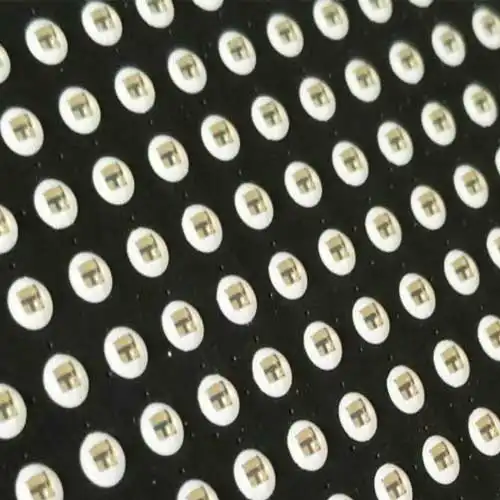
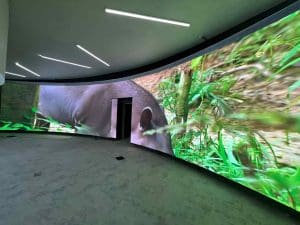
Application Scenario COB LED Display
1. MIP (Moulded Interconnect Packaging)
Technical Principle
- MIP is a new packaging technology where LED chips are directly fixed onto a transparent film. The conductive film connects the circuit, and the chips are sealed with a protective layer.
- It eliminates the need for traditional LED lamp bead brackets, making the display thinner and lighter.
Characteristics
- Does not use traditional lamp bead brackets; chips are directly integrated with the substrate.
- Encapsulation uses transparent and conductive films, reducing material consumption.
- Modules are ultra-thin and significantly lighter.
Advantages
- Ultra-thin Design: Suitable for lightweight and ultra-thin LED displays.
- High Contrast Ratio: Smooth surface provides more refined display effects.
- Strong Weather Resistance: The sealing process reduces environmental impacts (e.g., moisture, oxidation) on LED chips.
- Material Savings: Reduced packaging material usage lowers production costs.
Disadvantages
- High Technical Requirements: Complex production process with relatively low yield.
- Limited Applications: Currently less widely adopted and suitable for specific use cases only.
- Difficult to Repair: Once damaged, it is challenging to repair modules with film encapsulation.
Application Scenarios
- Ultra-thin and portable displays.
- Indoor advertising screens with strict weight and thickness requirements.
2. COB (Chip On Board)
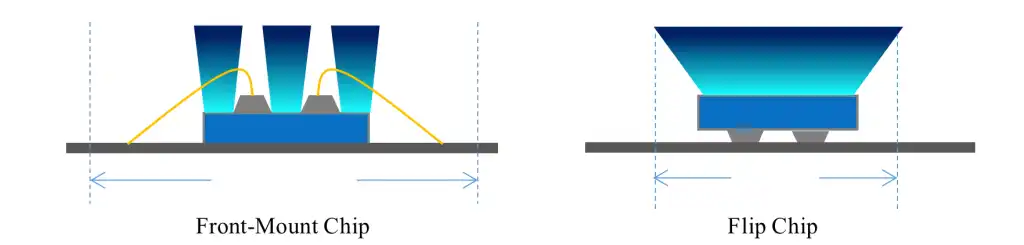
Full Flip-chip COB Design
Technical Principle
- COB technology mounts LED chips directly onto a PCB board.
- The chips are bonded using conductive glue or soldering, and the entire module is sealed with epoxy resin to protect the chips.
Characteristics
- No individual lamp bead encapsulation; chips are directly integrated with the PCB board.
- A protective layer (resin or silicone) is applied to the surface.
- Seamless design, ensuring no gaps between modules.
Advantages
- High Reliability: Strong encapsulation ensures excellent resistance to impact, moisture, and dust.
- Excellent Display Quality: Smooth surface, uniform brightness, and wide viewing angles.
- Superior Heat Dissipation: Chips are directly bonded to the PCB board, enabling efficient heat dissipation for long-term operation.
- Ideal for Small Pixel Pitch: Can achieve pixel pitches below P0.9, delivering ultra-high resolution.
Disadvantages
- Higher Production Costs: Complex processes and high precision requirements increase costs.
- Difficult to Repair: If a single chip is damaged, the entire module may need replacement.
- Not Suitable for Large Pixel Pitch: The cost increases significantly for larger pixel pitches.
Application Scenarios
- Small Pixel Pitch LED Displays: Conference room displays, monitoring centers, command centers, etc.
- High-Definition Indoor Displays: Displays requiring high resolution and long-term usage.
- Outdoor Weather-Resistant Displays: Displays used in high-humidity or harsh environments.
3. SMD (Surface Mounted Device)
Technical Principle
- SMD is the most widely used LED display technology today. LED chips are encapsulated into small plastic brackets (e.g., 5050, 3528 specifications) to form independent lamp beads, which are then soldered onto a PCB board using surface-mount technology.
Characteristics
- Each lamp bead integrates red, green, and blue chips for full-color display.
- Lamp beads are fixed to the PCB board through soldering.
- Mature and efficient production process.
Advantages
- Mature Technology: Established and simple production processes make it highly scalable and cost-effective.
- High Brightness: Suitable for both indoor and outdoor environments with excellent light efficiency.
- Easy Maintenance: Damaged lamp beads can be replaced individually without replacing the entire module.
- Versatility: Supports pixel pitches from P1.5 to P10 or even larger.
Disadvantages
- Lower Surface Flatness: Gaps between lamp beads make the surface less smooth compared to COB.
- Vulnerability to External Damage: Exposed lamp beads are prone to damage from physical impacts.
- Limitations for Small Pixel Pitch: Although advancements have enabled smaller pixel pitches, it is still less effective compared to COB for ultra-high resolution.
Application Scenarios
- Outdoor Advertising Displays: Building-mounted screens, large outdoor displays.
- Stage Rental Displays: Suitable for frequent assembly, disassembly, and transportation.
- General Indoor Displays: Displays with medium to low resolution requirements, such as shopping malls and conference rooms.
Detailed Comparison Table
| Comparison Dimension | MIP | COB | SMD |
|---|---|---|---|
| Technical Complexity | High | High | Medium |
| Production Cost | Medium | High | Low |
| Display Quality | High contrast, clear display | High precision, ideal for small pixel pitch | High brightness, suitable for large pixel pitch |
| Reliability | Medium | High | Medium |
| Weather Resistance | Good | Excellent | Fair |
| Suitable Pixel Pitch | Medium to small pitch | Ultra-small pitch (below P0.9) | Medium to large pitch (above P1.5) |
| Maintenance Difficulty | High | High | Low |
| Application Scenarios | Ultra-thin, portable displays | HD conference displays, small pixel pitch screens | Outdoor advertising, stage rental displays |
Conclusion and Recommendations
- MIP: Best suited for scenarios requiring ultra-thin and lightweight displays, such as portable or slim advertising screens. However, it has limited adoption due to high technical complexity.
- COB: The ideal choice for high-end small pixel pitch displays, particularly for scenarios demanding high resolution, durability, and excellent weather resistance. Its cost, however, is relatively higher.
- SMD: A mainstream and mature technology suitable for most indoor and outdoor applications. It is cost-effective, easy to maintain, and ideal for larger pixel pitches.